How to Calculate Daily Energy Consumption (Ah) on a Boat
Battery bank, solar and inverter decisions all rest on one number: your boat's daily amp-hour consumption. This guide shows you how to work it out realistically.
Calculating your boat's daily energy consumption in amp-hours (Ah) is the starting point for every decision about the battery bank, solar panels, alternator and inverter. A bank chosen without this number either runs flat on the second night at anchor or is carried around as unnecessary weight and cost. In this guide we work through the calculation step by step and size battery and charging capacity from a realistic example table.
The basics: A, Ah, W and Wh
- Current (A): the current a device draws at a given moment.
- Amp-hours (Ah): current × time. A device drawing 5 A for 3 hours uses 15 Ah.
- Power (W): voltage × current. 5 A at 12 V is 60 W.
- Watt-hours (Wh): power × time. The most accurate unit for comparison where different voltages are mixed.
The conversion is simple: Ah = Wh / V. On a 12 V bank, 1200 Wh is roughly 100 Ah; the same energy on a 24 V bank is roughly 50 Ah. That is why Ah figures should never be compared without stating the system voltage.
AC devices fed through an inverter
When 230 V devices run from the battery bank through an inverter, conversion losses must be included. Inverter efficiency is typically 85–93% depending on load. The calculation is: DC current = AC power / (battery voltage × efficiency). A 1000 W microwave on a 12.5 V bank at 88% efficiency draws about 91 A. An inverter also has a no-load consumption of several watts even with nothing connected; an inverter left on overnight is a noticeable item in the daily budget. For choosing the right unit, see our guide to inverter and charger selection.
Step-by-step method
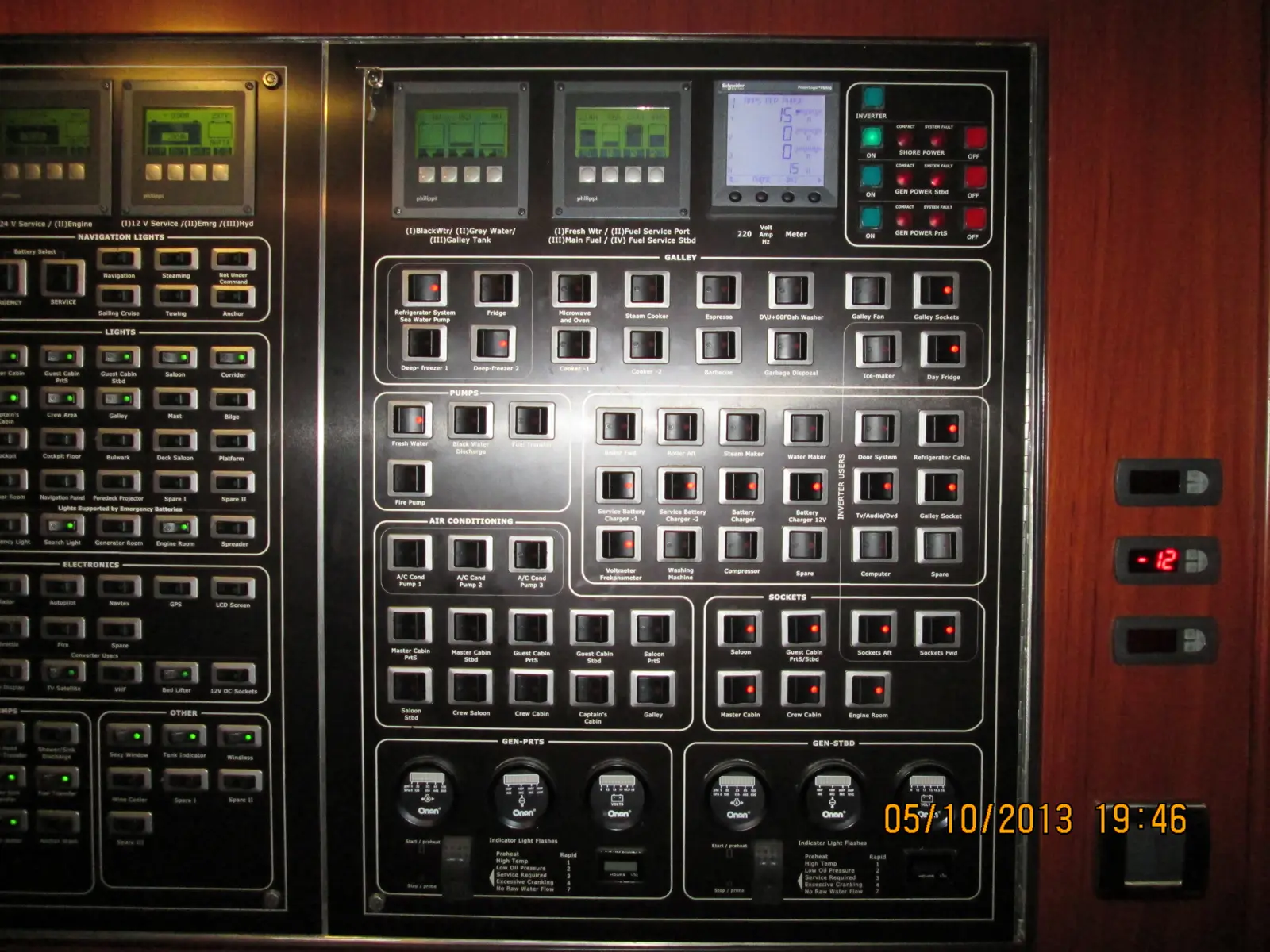
- List every consumer: lighting, fridge, pumps, navigation electronics, autopilot, communications, personal devices being charged and AC devices running through the inverter.
- Establish each device's current: use measurements rather than label values wherever possible. Switching a device on and off while watching a clamp meter or battery monitor is a practical way to see the difference.
- Estimate daily running time realistically: for intermittent devices such as fridges and pumps, account for the duty cycle.
- Separate by scenario: consumption profiles differ at anchor, under way and in the marina. The toughest scenario is usually days at anchor without shore power.
- Add it up and add a margin: for estimate-based figures, add a 15–25% safety margin.
Example table: 12 V sailing yacht, one day at anchor plus 4 hours under way
The table below is an example calculation for a 12 V sailing yacht at anchor in the Aegean summer, sailing about 4 hours a day. The values are typical ranges and should be replaced with figures measured on your own boat.
| Consumer | Current (A) | Time (h/day) | Consumption (Ah/day) |
|---|---|---|---|
| Compressor fridge (duty cycle ~40%) | 5 | 9.6 | 48 |
| Autopilot (under way) | 4 | 4 | 16 |
| Navigation electronics (MFD, instruments, AIS) | 3 | 4 | 12 |
| Interior LED lighting | 2 | 5 | 10 |
| LED anchor light | 0.2 | 10 | 2 |
| Fresh water pump | 6 | 0.5 | 3 |
| Phone, tablet, laptop charging | 3 | 3 | 9 |
| 4G router | 0.8 | 24 | 19 |
| Microwave (1000 W, via inverter) | 91 | 0.15 | 14 |
| Inverter no-load consumption | 0.8 | 4 | 3 |
| Total | 136 | ||
| With 20% margin (rounded up) | ≈ 165 |
Two points stand out: the fridge alone accounts for more than a third of the total, and small loads left on 24/7 (such as the router) end up competing with the big consumers. We look at how motor yacht and sailing yacht profiles differ in our comparison of motor yacht and sailing yacht electrical needs.
From consumption to battery bank
Once the daily requirement is known, the battery bank is sized by how many days you want to go without charging and by the usable capacity of the battery type.
- Lead-acid / AGM / gel: for service life, about 50% of capacity is generally considered usable. At high discharge currents, usable capacity falls below the rated value (usually a 20-hour discharge, C20).
- LiFePO4: 80–90% of capacity is comfortably usable and voltage stays stable throughout discharge. For 12.8 V lithium batteries the charge voltage is typically 14.2–14.4 V.
In our example, two days without charging at 165 Ah a day requires about 330 Ah of usable capacity. That means about 660 Ah nominal for lead-acid/AGM, or about 410 Ah of LiFePO4 at 80% usage. The weight and volume difference makes lithium especially attractive on sailing yachts; our lithium battery guide covers the switch. For technical reference, the Victron Lithium Battery Smart page shows the data for a typical lithium range.
From consumption to charging capacity
The energy used has to be put back every day. 165 Ah × 12.8 V ≈ 2.1 kWh/day. Assuming about 5 peak sun hours a day in the Aegean summer and a system factor of 0.75 for shading, temperature and angle losses, the panel power needed is:
2100 Wh / (5 h × 0.75) ≈ 560 W
So a solar installation of around 550–600 W could cover most of this boat's consumption in summer. Shading from the mast, boom and sails noticeably reduces yield on sailing yachts, and sun hours are shorter in spring and autumn. The alternator and generator close the gap. We cover panel placement and MPPT selection in our solar panel and MPPT installation guide.
A short motor yacht example
On motor yachts the same method applies with bigger numbers. A 1.5 kW air conditioner fed from a 24 V bank through an inverter and running continuously for 8 hours uses 12 kWh. At 90% inverter efficiency, that is about 520 Ah from a 25.6 V lithium bank. That is why air conditioning hours, bank capacity and next-day charging must be assessed together when planning a "silent anchorage" on a motor yacht.
Measure, don't guess
A calculation is a good start, but real consumption often turns out different from the estimate. A shunt-based battery monitor (such as the Victron SmartShunt) counts every amp-hour going into and out of the battery and reveals the real profile after a few days of use. Checking your plan against this data prevents both over- and under-investment. Monitoring solutions in the Victron Energy ecosystem also let you see these figures over the long term.
Work out your energy budget with Aslan Yacht
Our team in Turgutreis measures your boat's consumption on site at marinas around the Bodrum peninsula, draws up the energy budget and plans batteries, solar and charging accordingly. See our energy and battery systems service for details, or contact us to arrange a measurement visit.
Frequently asked questions
Should I use Ah or Wh?
On a single-voltage DC system, Ah is practical. Where 12 V, 24 V and 230 V devices are mixed, calculating everything in Wh first and then dividing by the battery bank voltage reduces errors.
Does the power rating on a device label show real consumption?
Usually not. The label often shows the maximum; devices such as fridges, pumps and autopilots run intermittently. Measuring real average consumption with a shunt-based battery monitor is the most reliable method.
How much safety margin should I add?
For estimate-based calculations, 15–25 percent is reasonable. With measured data the margin can be smaller, but some allowance should always remain for battery ageing and seasonal changes.