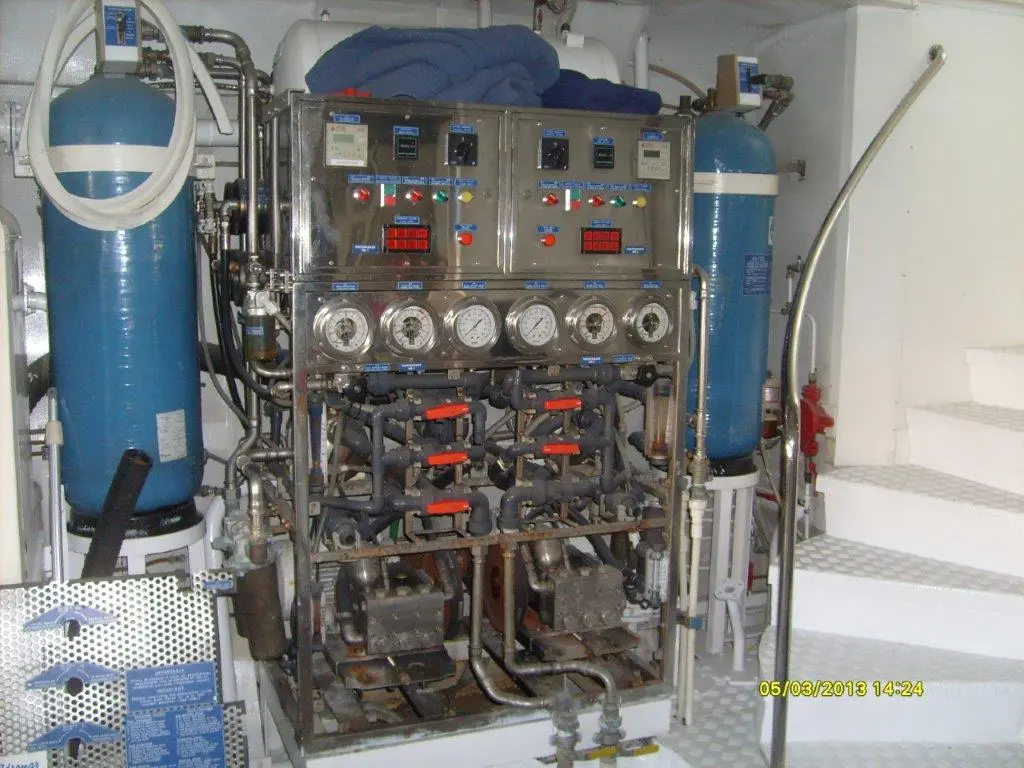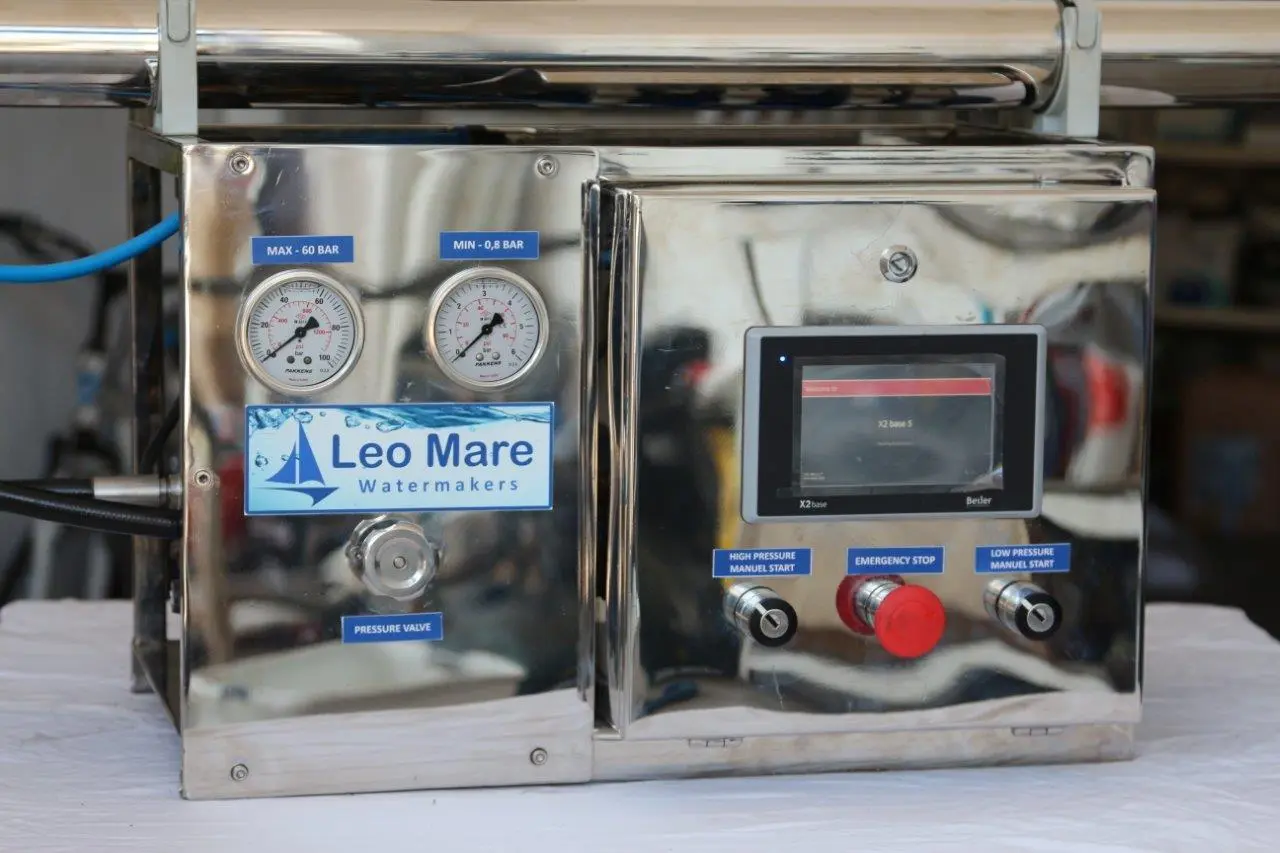
Leo Mare Watermakers is Aslan Yacht's own watermaker line. Design, assembly, testing and commissioning all happen at our workshop in Turgutreis. The result is a reverse-osmosis system with a stainless-steel frame, PLC automation and a colour touch-screen control panel, built to be configured to each boat. This page explains why we build it locally, how it works, what configuration options are available, and how installation and maintenance are handled.
Why a locally built watermaker
When an imported watermaker breaks down, owners are often stuck waiting on a part or on support from abroad — costly in both time and money. Building Leo Mare in our own workshop removes that dependency:
- Service and spare parts on hand in Bodrum: because we design the system ourselves, parts supply doesn't depend on an import chain, and we can respond quickly from our Turgutreis workshop if something needs attention.
- Customised to your boat: frame size, pump placement and panel position are planned around the actual space available in the engine room, the boat type (motor yacht, sailboat, gulet or catamaran) and the existing power supply.
- PLC automation with automatic fresh-water flush: after each use, the system automatically flushes the membrane with fresh water, cutting down salt build-up and bacterial growth and helping protect membrane life.
Every Leo Mare unit is also run and pressure-tested at our workshop before it goes to a boat — pump, valves, sensors and PLC/HMI communication are all checked ahead of commissioning. That shortens installation time on board and avoids surprises in the field.
You can read this alongside our general watermaker maintenance service, which covers every brand: see Watermaker service for details on maintenance, membrane and pump servicing.
How it works: the reverse-osmosis steps
Like any watermaker, Leo Mare works on the reverse-osmosis principle. The steps run in this order:
- Seawater intake: seawater is drawn in through the boat's intake valve.
- Pre-filtration: the water passes through staged pre-filters that remove sand, silt and organic particles, protecting the high-pressure pump and the membrane.
- Pressurisation: a high-pressure pump, driven by an electric motor, raises the water to the pressure the membrane needs; this is monitored on the pressure gauges (bar).
- Membrane pass (reverse osmosis): the pressurised water is forced through a semi-permeable membrane; pure water molecules pass through while salt and minerals are held back.
- Pressure regulation: a pressure-regulating valve continuously balances system pressure for efficient, stable membrane operation.
- Salinity check: the produced water passes a salinity sensor for quality confirmation; out-of-spec water is automatically diverted back to the sea.
- Delivery to the tank: approved fresh water is routed to the boat's fresh-water tank.
- Automatic fresh-water flush: once the system stops, the membrane is automatically flushed with fresh water so it's ready for the next run.
Every one of these steps is monitored by the PLC controller, and the colour touch-screen HMI shows production values and pump status in real time. We cover the general reverse-osmosis principle and capacity sizing in our post how a watermaker works and choosing capacity, and the maintenance steps that keep a membrane healthy in watermaker membrane maintenance.
Configuration options
Leo Mare isn't an off-the-shelf box; it's configured per project. Each installation is planned around these options:
- Power supply: electric motor options in 230V AC, 400V three-phase or 24V DC; the right choice depends on your boat's existing electrical infrastructure (generator, shore power or battery bank).
- Production capacity: rather than a fixed capacity, sizing is based on your boat's length, crew and guest numbers and how you use the boat. Contact us for exact figures and a quote.
- Remote control panel (optional): the main unit stays in the engine room, while a second monitoring/control panel can be added at the helm or saloon.
- Frame and layout: the stainless-steel frame is sized to the available space, with pump, filter and valve layout planned for easy maintenance access.
We work through which of these options suits your boat together, taking your existing systems — such as sailboat electrical systems — into account. Motor yachts with a generator typically take 230V AC or 400V three-phase, while sailboats with a strong battery bank may be better suited to a 24V DC configuration; we decide this alongside an on-site power budget check.
Installation, commissioning and maintenance
Installation starts with the unit, built at our workshop, being brought aboard and mounted in the engine room. Once the seawater intake/discharge lines and the fresh-water tank connection are in place, the electrical connection is completed for the chosen power supply. During commissioning, the system is pressure-tested, PLC parameters are set for the boat, and produced-water salinity is verified.
Because the same team builds Leo Mare, we also handle its ongoing maintenance: pre-filter changes, membrane checks, pressure testing, and troubleshooting any electrical issues on the PLC/HMI side. If a boat won't be used for an extended period, we apply pickling (a protective chemical fill); at the start of the season we flush the system with fresh water and pressure-test it before handover. See our general watermaker maintenance scope on Watermaker service, and our approach to factory-backed service on authorized service.
Leo Mare vs an off-the-shelf imported unit
| Criterion | Leo Mare Watermakers | Off-the-shelf imported unit |
|---|---|---|
| Service access | Direct service from the Turgutreis workshop, no middleman | Usually routed through an importer/distributor, which can take longer |
| Spare parts | Stock and supply controlled by the builder, in Bodrum | Often depends on ordering from abroad and customs clearance |
| Customisation | Frame size, panel layout and power supply engineered per boat | Standard product range; the boat has to be fitted around it |
| Control | PLC automation and touch-screen panel, tuned to the boat's own parameters | Varies by brand and model; customisation can be limited |
Work with Leo Mare
Leo Mare Watermakers comes out of Aslan Yacht's own workshop in Turgutreis — designed, assembled and tested by us from the ground up. Whether you're planning a new watermaker installation or considering switching your current system to Leo Mare, get in touch and we'll work out capacity and configuration together, based on your boat type, existing electrical infrastructure and how you use the boat.