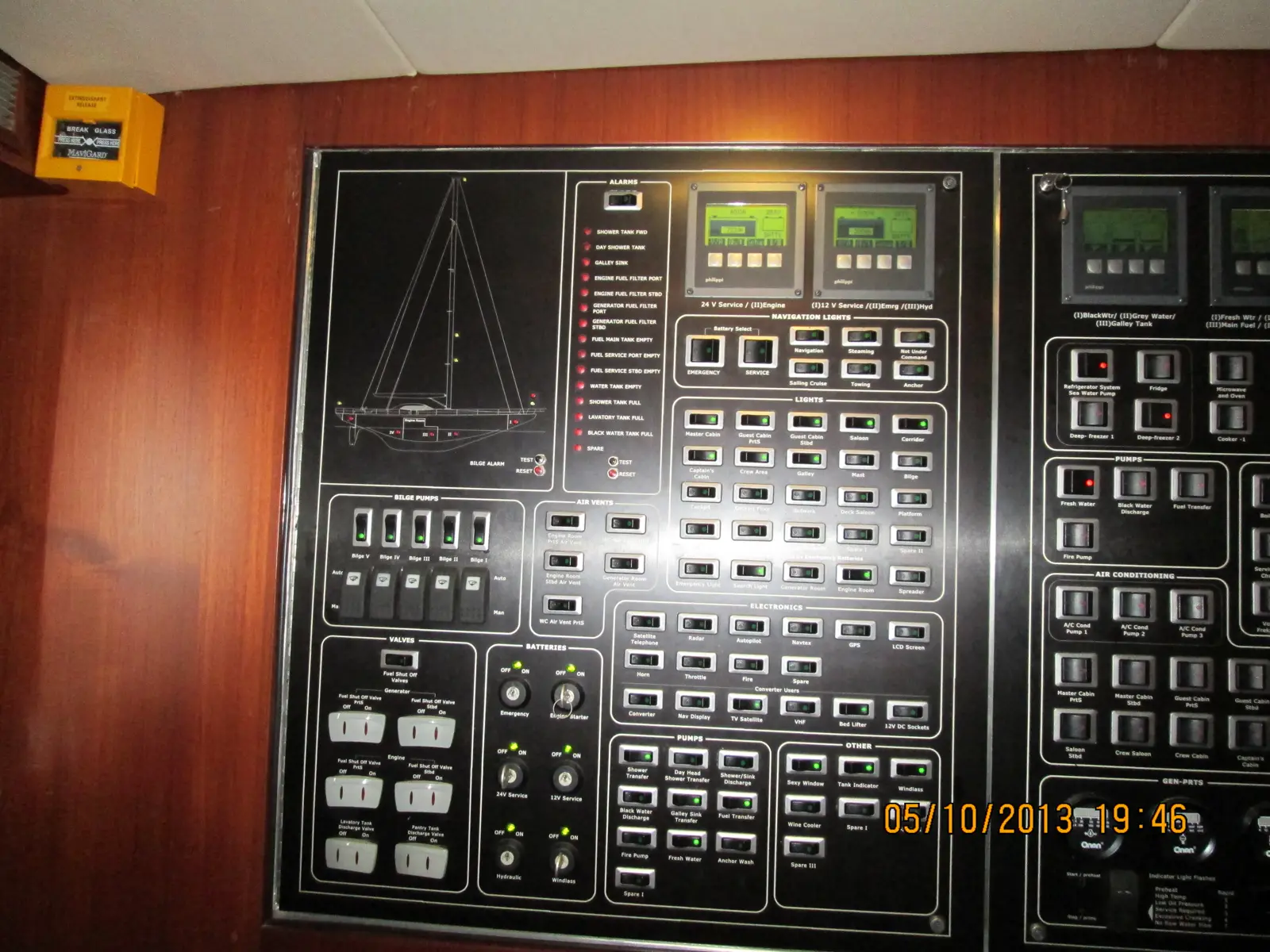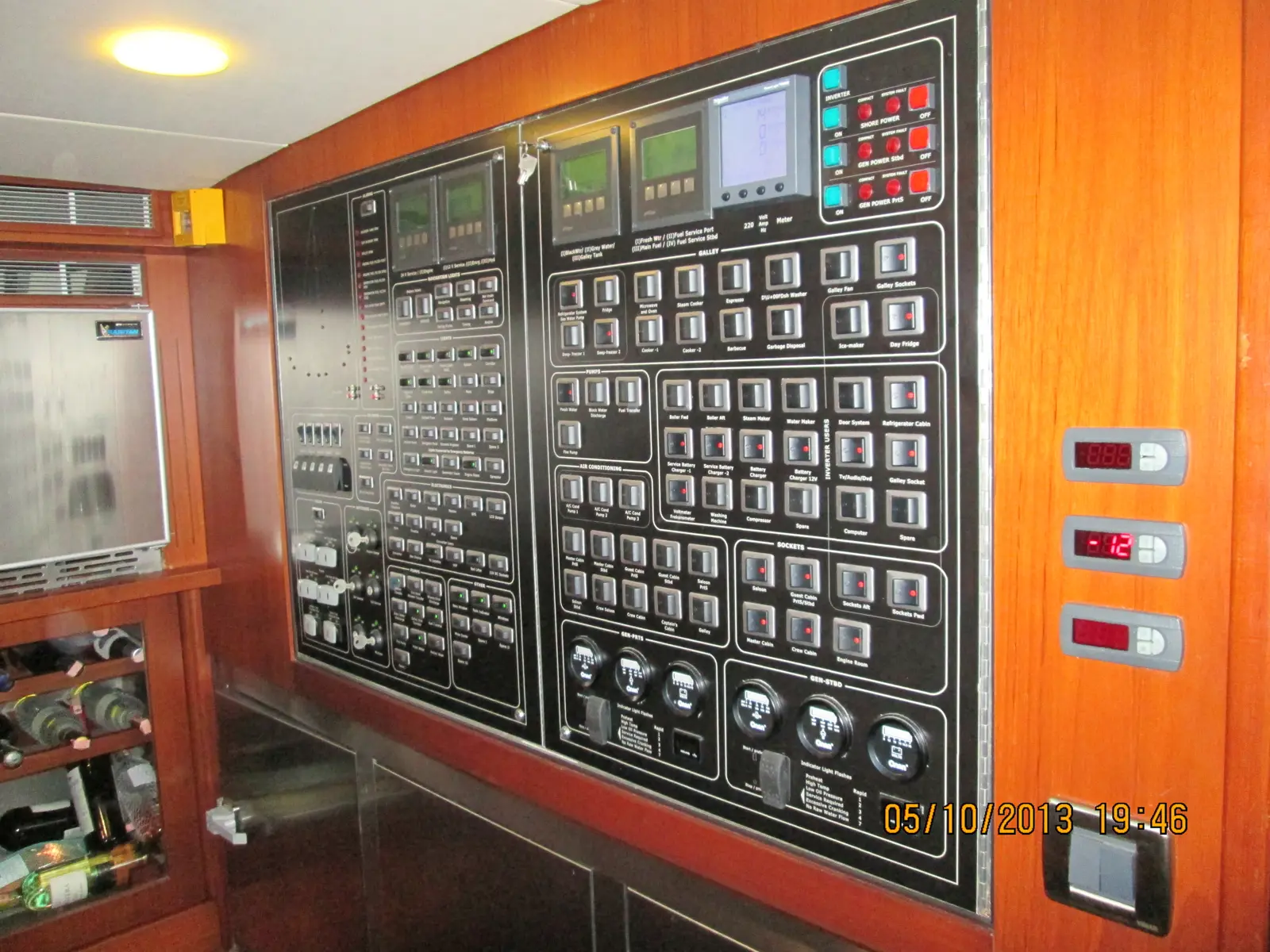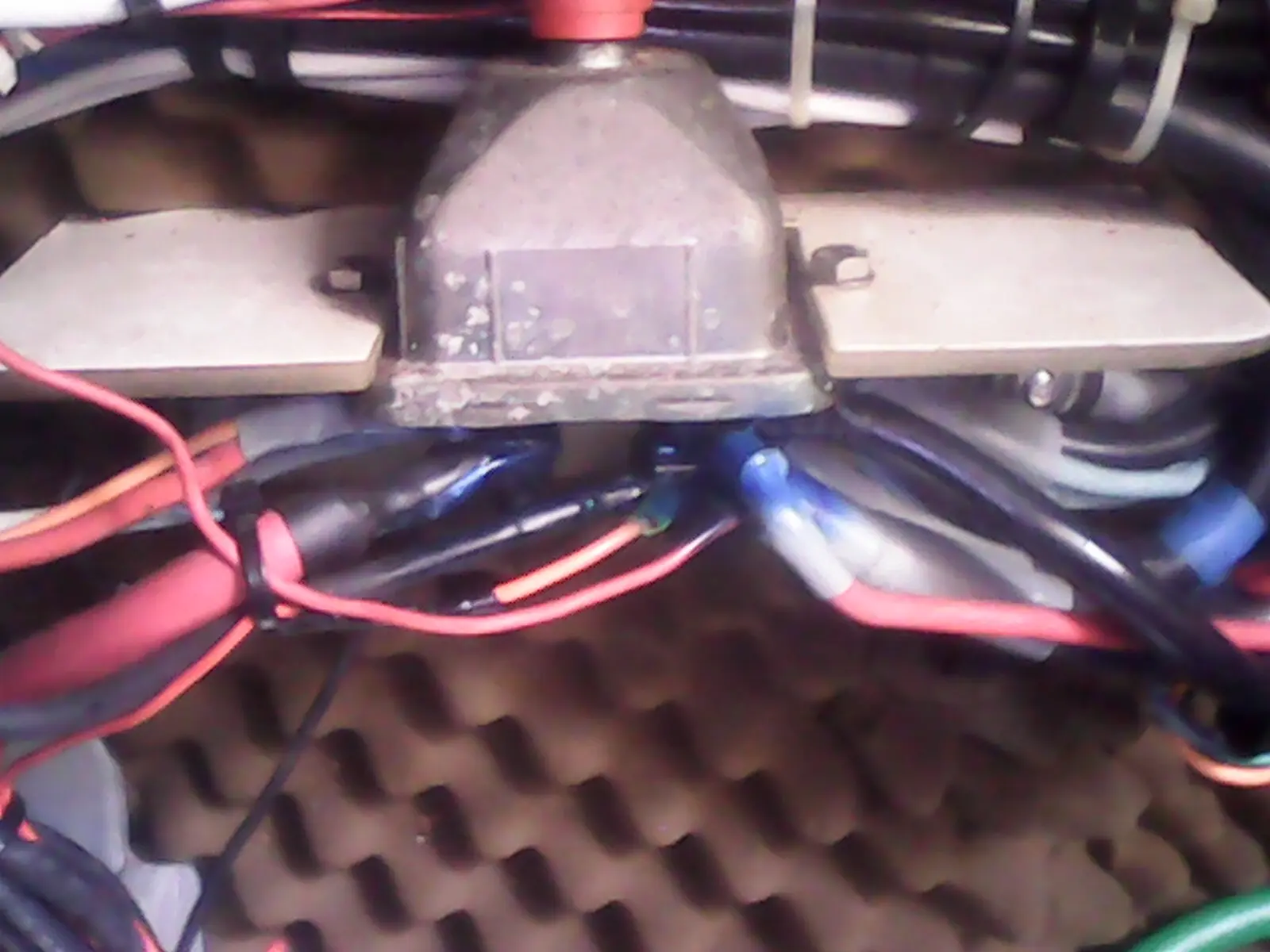
Electrical fires on boats: risks, causes and prevention
Many boat fires start at a terminal that has been quietly overheating for months. Here is how to read the risks and which measures actually work.
An electrical fire on a boat rarely starts with a sudden short circuit; far more often it starts at a connection that has been slowly heating up for months. Inside a closed engine room, surrounded by fuel vapour, resin and insulation, a single terminal can reach a critical temperature without anyone noticing. This article brings together the typical risk points we see during service work around Bodrum, the physics behind them and the measures that actually help.
The physics of an electrical fire: where does the heat come from?
The heat released in a conductor follows P = I² × R. Current acts as a square, so if the terminal resistance on a battery cable carrying 100 A rises by just 0.005 Ω, that point becomes a continuous 50 W heat source. That is the output of a small soldering iron, trapped for hours under a tightly closed terminal cover.
Two variables therefore decide the fire risk: the magnitude of the current and the increase in contact resistance. High-current loads such as inverters, bow thrusters, windlasses and heaters draw hundreds of amps on 12 V and 24 V DC systems. The same power travels at much lower current on 230 V AC, but on the AC side a loose socket or a corroded shore power plug heats up through exactly the same mechanism.
The most common risk points on board
The places where we find fire damage or scorch marks repeat themselves:
- Battery terminals and busbar connections: nuts tightened to the wrong torque, contact surfaces spoiled by washers or fuses stacked in between, dissimilar metals in contact.
- Shore power inlet and cable plug: pins oxidised by sea air, plugs that do not seat fully, high-power loads on a 16 A cable. See our guide to shore power connections in the marina for details.
- Around chargers and inverters: lockers with blocked ventilation, lines or spares stacked right against the unit.
- Undersized cables: extensions for a later fridge or watermaker made with "whatever cable was on board". Our article on cable sizing and voltage drop shows how to get it right.
- Chafe and bend points: cables passing through bulkheads that rub against an edge with engine vibration until the insulation wears through.
- Unprotected cables: positive leads that run for metres from the battery before they reach any fuse.
Two smaller but sneaky sources belong on this list too: old halogen spotlights mounted close to fabric or timber, and 12 V accessory sockets added later. Halogen bulbs run very hot at the surface; converting to LED cuts both consumption and heat. In accessory sockets, loose spring contacts and thin feed cable can melt under sustained loads.
Overcurrent protection: the fuse protects the cable
A fuse protects the cable, not the appliance. The E-11 standard published by ABYC and ISO 13297, which sets the rules for AC/DC installations on small craft, share the same principle: every positive conductor must be protected as close as practical to its power source by an overcurrent device matched to the cable's ampacity. For battery connections ABYC E-11 generally limits this distance to 7 inches (about 18 cm), with defined exceptions.
A frequent mistake is upsizing a fuse "so it stops blowing". Feeding a 4 mm² cable through a 40 A fuse means that in a fault the cable can overheat and melt its insulation before the fuse opens. If a fuse keeps blowing, the problem is in the load or the cable, and the cause must be found before any rating is changed.
On lithium (LiFePO4) banks the short-circuit current can reach thousands of amps, so the fuse's interrupting capacity matters too. That is why main lines use Class T or MRBF/ANL fuses with a suitable breaking capacity. We explain which type fits which case in our article on ANL, MRBF and Class T fuse selection. If you are planning a switch to lithium, also read our LiFePO4 conversion guide: BMS, fusing and cable design must be considered together.
| Circuit | Typical risk | Correct practice |
|---|---|---|
| Battery → main switch | Long unprotected positive cable | Main fuse close to the battery terminal (MRBF / Class T) |
| Main busbar → inverter | High current, overheating lug | Correct cross-section, hydraulically crimped lug, torqued to spec |
| Panel → loads | Thin cable, oversized fuse | Fuse rating chosen for cable capacity |
| Shore power inlet | Oxidised plug, loose pin | Double-pole breaker near the inlet, plug and socket checks |
| Charger / inverter | Poor ventilation | Manufacturer's clearances respected, free airflow |
Workmanship: lugs, torque and cable routing
Good materials with poor workmanship still create a fire risk. These are the basic rules we apply in the workshop and on board:
- Use tinned, finely stranded marine cable. Solid household cable fractures under vibration.
- Crimp lugs with the correct tool; use a hydraulic crimper from 25 mm² upwards. A lug squashed with pliers works at first but loosens over time.
- Seal the lug barrel with adhesive-lined heat shrink to keep moisture out.
- Tighten terminal nuts to the manufacturer's torque and limit the number of lugs per busbar stud.
- Secure the cable route: use grommets at bulkhead penetrations, keep clear of hot exhausts and moving parts, and support roughly every 45 cm.
- Label and document: it should be clear which fuse feeds each circuit. In an emergency this saves minutes.
On older boats, years of additions gradually undo most of these rules. When a full rework is needed, our yacht electrical services cover the whole path from the panel to the battery bank.
Batteries, charging and energy equipment
Flooded lead-acid batteries release hydrogen in the final stage of charging, so the battery compartment must be ventilated and kept away from ignition sources. AGM and gel batteries gas far less but can still do so when overcharged. On LiFePO4 batteries, test that the BMS protections for high voltage, low voltage, overcurrent and temperature really can disconnect the circuit.
Even quality chargers, inverters and DC-DC converters must be installed under the manufacturer's conditions. Manufacturers such as Victron Energy state the required cooling clearances and cable sizes clearly in their installation manuals; do not shrink them just because the locker door no longer closes. For energy system design and upgrades, see our energy and battery systems page.
Detection, extinguishing and emergency readiness
Detecting early matters as much as preventing:
- Smoke detectors in cabins and saloon; heat detection or an automatic suppression system in the engine room.
- CO₂ or dry chemical extinguishers suitable for electrical fires, with expiry dates and pressure gauges checked.
- Every crew member knows where the main battery switch is, and it is easy to reach.
- The shore power inlet breaker location is known, and the pedestal supply can be cut if needed.
- A thermal camera scan under load was done at the start of the season.
- Any burning smell, discoloured lug or melted heat shrink leads to the circuit being isolated and inspected.
A burning smell is never something to "look at later". If you cannot find the source, switch off the circuits concerned and have the boat checked.
Work with Aslan Yacht on electrical safety
From our workshop in Turgutreis we visit marinas and boatyards across the Bodrum peninsula to assess your boat's wiring with a thermal camera, torque checks and fuse-to-cable matching. We prioritise and report every risk point we find. To plan an inspection, get in touch with us or explore our yacht electrical services.
Frequently asked questions
Where do electrical fires on boats usually start?
In the field we most often find them at battery terminals, the shore power inlet, around chargers and inverters, and at loose or corroded connections in the engine room. The common factor is high current combined with rising contact resistance.
Can water be used on an electrical fire?
Never spray water on an energised circuit. If it is safe, first open the main battery switch and disconnect shore power, then use a CO₂ or dry chemical extinguisher rated for electrical fires; for lithium battery fires follow the manufacturer's guidance.
How often should a thermal camera inspection be done?
We recommend a thermal scan under load at least once at recommissioning and after any major load change such as a new inverter, air conditioning or watermaker. A terminal that looks clearly hotter than its surroundings is an early warning.