How Does a Watermaker Work? Choosing the Right Capacity
From the basic principle of reverse osmosis to calculating your daily water needs: how to choose the right watermaker capacity and electrical setup for your yacht.
A watermaker is a reverse osmosis system that forces seawater through a semi-permeable membrane at high pressure to produce fresh water. Sized correctly, with the electrical infrastructure built around it, a watermaker cuts a yacht's dependence on marina water; sized wrongly, it either runs the generator needlessly or never quite keeps up with demand. This article walks through how the system works and how to calculate the right capacity for your boat.
Reverse osmosis: the pressure that separates the salt
When a semi-permeable membrane separates salt water from fresh water, water naturally moves from the fresh side to the salty side — this is osmosis. In the Aegean and Mediterranean, salinity runs around 38–39 g/l, giving an osmotic pressure above 25 bar. Reverse osmosis pushes well beyond that pressure to reverse the flow: water molecules pass through the membrane while most of the salt ions are left behind.
Yacht-class systems typically operate at 55–62 bar. Seawater membranes are usually rated up to around 69 bar (1000 psi); pushing close to that limit stresses both the membrane and the high-pressure circuit. Only a small fraction of the feed water becomes product water (permeate); the rest is discharged overboard as concentrated brine, typically 8–15% recovery on small yacht systems.
The main components of a watermaker
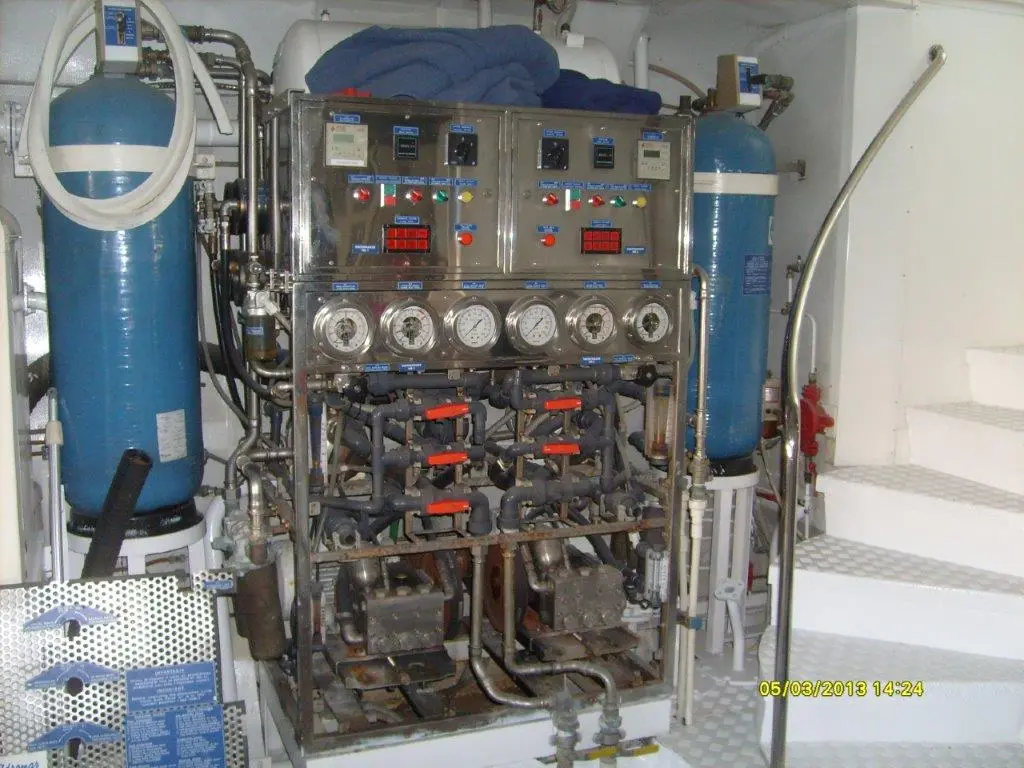
In a typical AC-motor yacht watermaker, water follows this path:
- Seawater intake and strainer: Catches coarse particles. The intake should sit clear of bilge or grey-water discharges and stay submerged and air-free while underway.
- Booster (feed) pump: Draws water through the pre-filters and delivers it to the high-pressure pump at positive pressure.
- Pre-filters: Usually 20 µm and 5 µm cartridges. The pressure differential across the filter is the best indicator of when to change it.
- High-pressure pump: Typically a piston (plunger) pump with an electric motor — the single biggest power consumer in the system.
- Membrane housings: Pressure vessels containing spiral-wound thin-film composite (polyamide) membranes.
- Pressure regulating valve and gauges: Sets working pressure and controls flow to the brine line.
- Salinity probe and three-way valve: Diverts product water to waste rather than the tank if TDS/conductivity exceeds the target.
- Freshwater flush circuit: Clears salt water from the membrane after shutdown; includes an activated-carbon filter so chlorine never reaches the membrane.
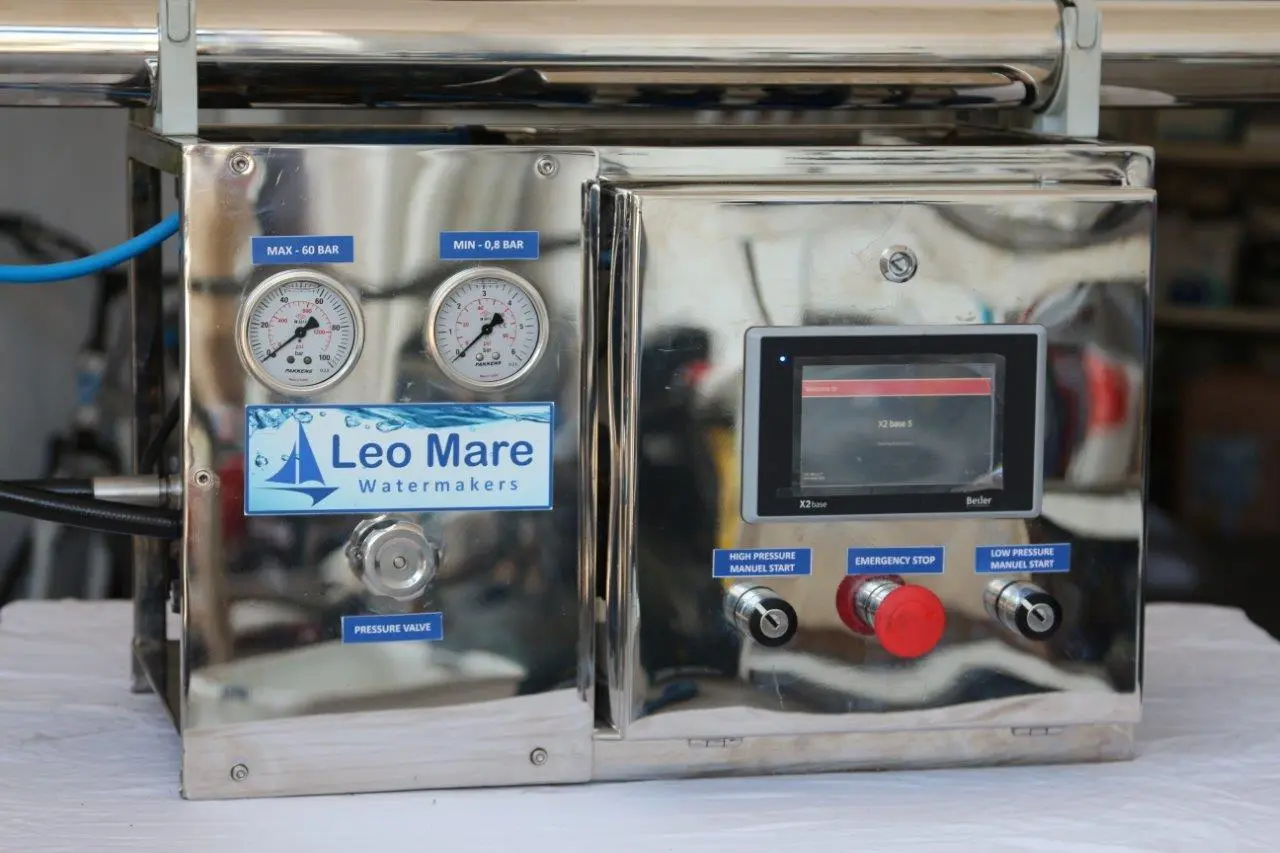
In our Leo Mare watermakers this sequence is managed by a PLC: pressures, product water quality and run hours are monitored on a touch screen, and the flush cycle runs automatically. The stainless steel frame is built for the humid engine-room environment.
Sizing capacity: from daily needs to l/h
Sizing should start from the boat's real usage, not a catalogue figure. The process:
- Establish daily consumption per person. Showers, galley, heads and freshwater toilets typically add up to 80–150 litres per person on a motor yacht. Boats with seawater flush toilets sit toward the lower end.
- Add secondary loads. Deck and tender washdown, laundry, dishwasher and rinsing toys can add hundreds of litres a day.
- Define the running window. A watermaker usually runs while the generator is on or underway. How many hours a day you plan to run it sets the required hourly capacity.
- Add a margin for temperature and ageing. Catalogue figures are usually quoted at 25°C. Aegean water can drop to 16–18°C in spring, cutting output noticeably. Membranes also lose output with age; a 20–30% margin is a reasonable starting point.
Example: an 8-guest motor yacht at 110 l/day per person plus 200 l of deck washdown comes to roughly 1080 l/day. If the generator runs 5 hours a day, that's 216 l/h; with the temperature and ageing margin, a unit in the 250–300 l/h class makes sense.
| Boat type (example) | Daily need (approx.) | Run time | Suitable class |
|---|---|---|---|
| 40–45 ft sailing yacht, 4 guests | 300–400 l | 4–5 hours | 60–100 l/h |
| 50–60 ft motor yacht, 6–8 guests | 800–1100 l | 5–6 hours | 150–250 l/h |
| 70 ft+ motor yacht / gulet | 1500 l and up | 6–8 hours | 250 l/h and up |
This table is only a starting point; tank volume, guest profile and cruising plan will shift the result.
The balance between tank volume and capacity
A large freshwater tank lets you run the watermaker less often but for longer; on boats with small tanks, the unit needs to run nearly every day. From the membrane's point of view, regular running is healthier than sitting idle for weeks at a time. So instead of choosing an oversized unit and running it only a few times a month, a capacity that comfortably covers daily demand in a reasonable window usually works out better. Sailing yachts are a different case: on boats without a generator, energy-recovery 12/24V DC systems make water at a lower flow rate without overloading the battery bank.
The electrical side: power, inrush current and the generator
Most watermaker sizing problems show up on the electrical side. The motor driving the high-pressure pump draws several kW depending on capacity, and across-the-line starting can pull several times its rated current at start-up. On an undersized generator this can cause voltage sag and drop other loads offline.
Points to watch:
- Supply type: Small systems typically run on 230V single-phase; larger systems mostly use 400V three-phase motors. 12/24V DC energy-recovery systems are a separate class for sailing yachts.
- Starting method: A soft starter or variable-frequency drive reduces inrush current and protects the pump mechanically.
- Generator sizing: Calculate total load assuming the watermaker runs alongside the air-conditioning, water heater and galley loads. We cover the generator side in more detail in our generator maintenance guide.
- Running from an inverter: Small AC watermakers can run off a large inverter and battery bank, but the inrush current and hours-long load draw the bank down fast. Check this scenario against the method in our inverter selection guide.
- Cable and protection: The motor circuit needs correctly sized cable, motor protection breaker and earth-leakage protection, installed to the AC system principles in ISO 13297 and ABYC E-11.
Planning the whole electrical infrastructure together as part of our energy and battery systems service avoids surprises later.
Installation location and water quality
A watermaker's performance doesn't depend on the unit alone. A dedicated, clean seawater intake, positioning the high-pressure pump at or below the level of the membranes, and leaving service access to filters and gauges all save time in the long run. A sample point on the product-water line makes TDS checks easy.
Using product water as drinking water also puts weight on tank cleanliness and distribution-line hygiene. For a general framework on drinking-water quality, the WHO drinking-water guidelines are a good reference. On the membrane side, manufacturer technical data — for example DuPont FilmTec SW30 seawater elements — sets the pressure, temperature and pH limits.
Once installed, usage habits are what really determine membrane life; we cover flushing, chemical cleaning and lay-up procedures in detail in our watermaker membrane maintenance guide.
Plan your watermaker with Aslan Yacht
At our workshop in Turgutreis we build Leo Mare watermakers with PLC control and a stainless steel frame, and we also service other-brand systems across the Bodrum peninsula's marinas. To size your boat's daily water need against generator and battery capacity and choose the right unit, take a look at our watermaker service page or get in touch with us.
Frequently asked questions
Can a watermaker run while alongside in a marina?
It isn't recommended. Marina water can carry oil, fuel residue and fine silt that quickly clog the pre-filters and permanently foul the membrane. It's best to run the unit in clean, open-water anchorages.
Is watermaker product water drinkable?
A properly working reverse osmosis system rejects the vast majority of salt and particulates, and product water is typically below 500 ppm TDS. Tank hygiene, storage and, where needed, UV sterilisation should still be addressed separately for drinking-water safety.
Why does watermaker capacity drop in cold water?
Membrane water permeability falls as temperature drops. Catalogue figures are usually quoted at 25°C; when seawater drops to 15–17°C the same pressure yields noticeably less product water, so it pays to build in a margin when sizing a unit.