Watermaker Membrane Care: Flushing, Chemical Cleaning and Winterizing
The membrane is a watermaker's most expensive and most sensitive part. Here's how correct flushing, timely chemical cleaning and proper winterizing extend its life.
Watermaker membrane care determines both the unit's lifespan and the quality of the water it produces. Membranes can run trouble-free for years, but one left sitting unflushed for a few weeks, or exposed to chlorinated water, can be ruined within a single season. This article covers a practical maintenance routine — from daily flushing to chemical cleaning and winterizing.
What wears a membrane out?
Spiral-wound thin-film polyamide membranes used in yacht watermakers face four main threats:
- Biofouling: When the unit sits idle full of salt water, bacteria and algae form a biofilm on the membrane surface. Warm Aegean summer water speeds this up.
- Scaling: Calcium carbonate and similar salts deposit on the membrane surface, especially on the concentrate side.
- Colloidal and particulate fouling: Fine silt, sediment and sand that slip past the pre-filters clog the membrane's feed channels.
- Chemical damage: Chlorine and other oxidisers irreversibly break down the polyamide layer. Oil and fuel residue also stick to the surface and reduce permeability.
That's why the first rule of maintenance is simple: never run a watermaker in a marina, at a harbour mouth or in turbid water.
Pre-filters: the membrane's first line of defence
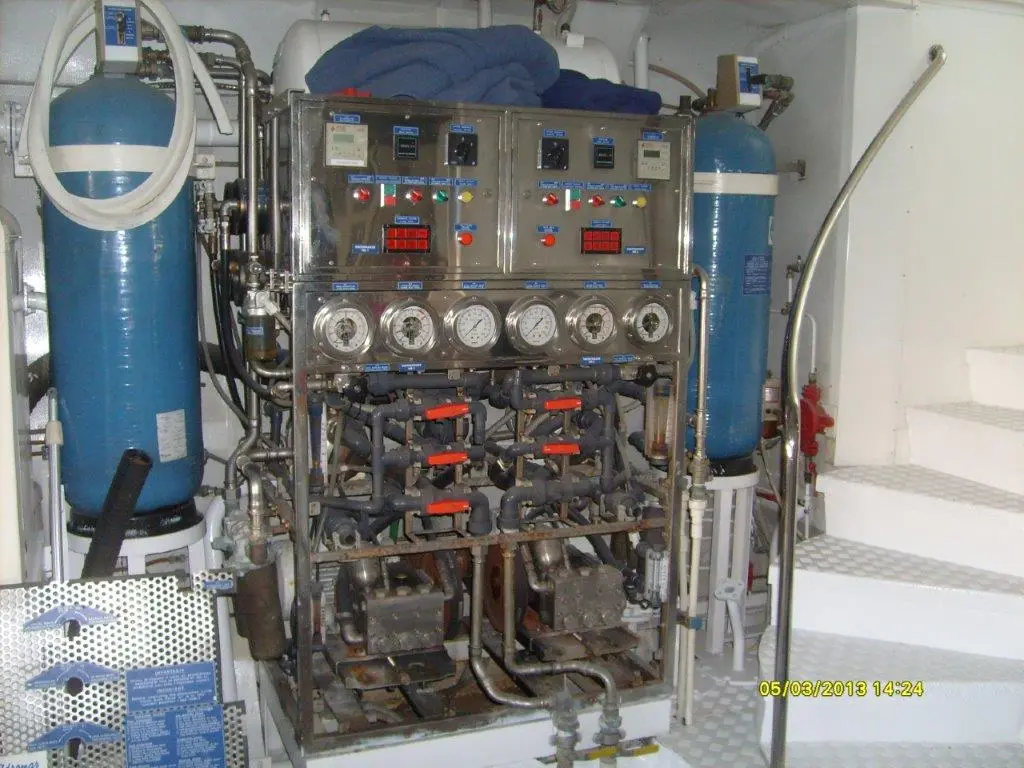
The cheapest way to protect a membrane is to never neglect the pre-filters. In a typical yacht system, seawater passes through a coarse strainer, then 20 µm and 5 µm cartridges. A clogged cartridge drops feed pressure, starves the high-pressure pump and triggers cavitation at the pump valves. Rinsing and reusing a cartridge may seem tempting, but once its fibre structure breaks down it can let fine particles through to the membrane. After a cartridge change, clean the housing and check the O-rings are properly seated to keep air out. Keep spare cartridges dry and sealed on board.
Daily use and freshwater flushing
The system should be flushed with fresh water after every run. Flushing clears salt water out of the membrane and pump, slowing biological growth and corrosion. The water used must be chlorine-free, which is why the flush circuit includes an activated-carbon filter. The unit's own product water should be used whenever possible.
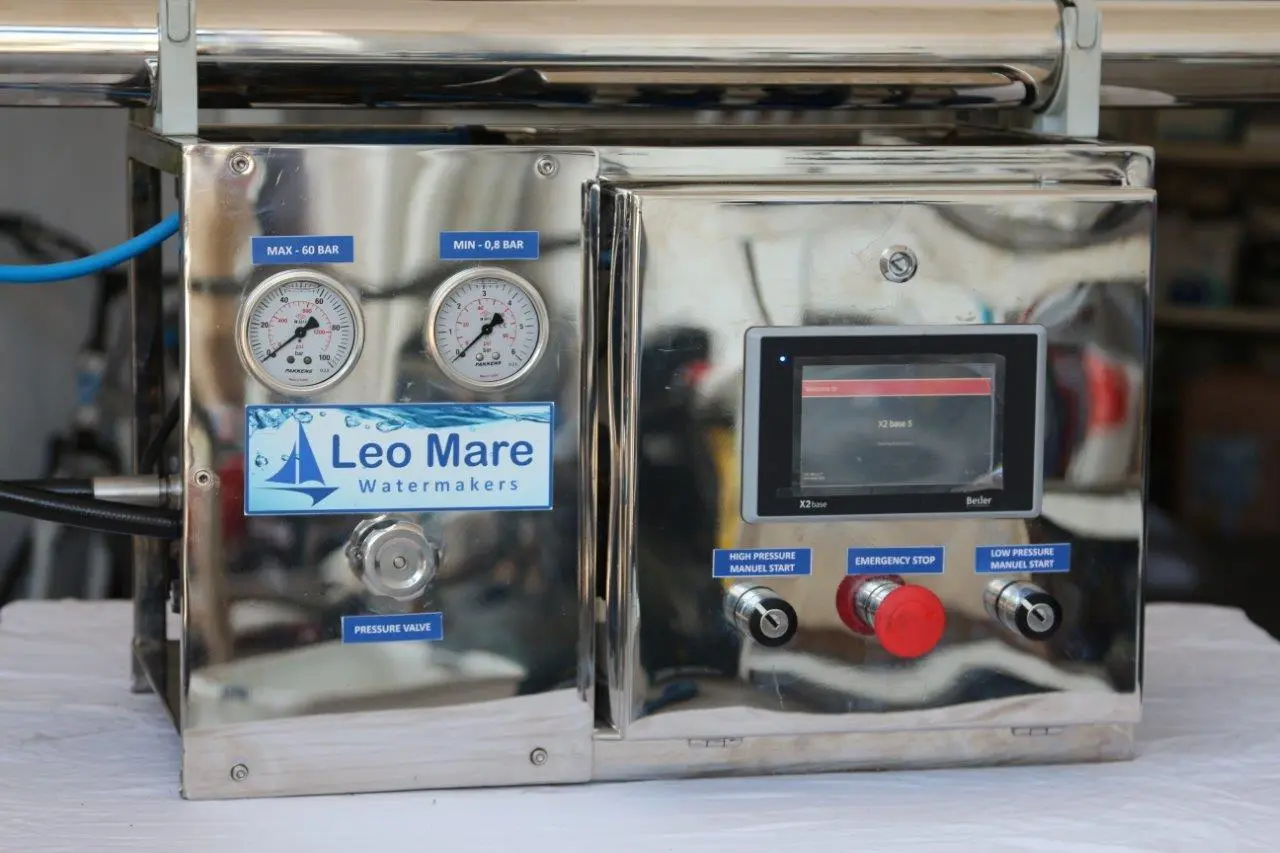
On our Leo Mare systems, the PLC runs the flush automatically on shutdown and can be set to repeat it at fixed intervals if the unit sits unused for longer. On systems without automatic flushing, crew need to build this into a routine.
Daily checklist:
- Note the pre-filter pressure differential; replace the cartridge if it has risen.
- Log working pressure, product flow rate and TDS at the same water temperature.
- Check the seawater strainer and intake line; air ingress stresses the pump.
- Check high-pressure fittings for drips or salt crystals.
- Confirm the flush has completed fully after shutdown.
Tracking performance: what the numbers tell you
The best way to catch membrane problems early is to keep records. Because product flow varies with temperature, compare readings under matching conditions or correct them with the manufacturer's normalisation tables. A widely used rule of thumb: schedule a chemical clean once normalised product flow drops 10–15% or salt passage rises noticeably.
| Symptom | Likely cause | Action |
|---|---|---|
| Product flow drops at the same pressure | Biofilm, scale or fouling | Check filters, consider chemical cleaning |
| Product water TDS rises | Scaling, O-ring leak, chemical damage | Check membrane housing seals and clean, then reassess |
| Filter pressure differential rises fast | Turbid water, marina water | Change running location, replace cartridges |
| Working pressure fluctuates | Air ingress, pump valves, booster pump | Service the intake line and pump |
| Bad odour | Biological growth in stagnant salt water | Alkaline cleaning and disinfection |
Manufacturer data sets the pressure and temperature limits — for example, the DuPont FilmTec SW30 series is a widely used seawater element in yacht applications, and its datasheets state working ranges clearly.
Chemical cleaning: alkaline and acid
Chemical cleaning isn't routine maintenance — it's a response to specific performance data. General approach:
- Alkaline cleaning: A high-pH solution for biofilm, organic fouling and oily residue. In most cases alkaline cleaning is done first.
- Rinse: Drain the solution fully and rinse the system with chlorine-free fresh water.
- Acid cleaning: A low-pH solution, typically citric-acid based, for scale and metal oxide deposits.
- Final rinse and test: Run the system at low pressure, divert the first product water to waste, then re-measure TDS and flow.
Cleaning solution is circulated at low pressure, never at working pressure. Solution temperature must stay within the membrane's limits and pH within the manufacturer's cleaning range. Mixing cleaning chemicals or using them in the wrong order can damage the membrane.
Recording the results after cleaning matters. If product flow and TDS at the same temperature and pressure clearly improve versus before cleaning, the membrane is still healthy. If there's no improvement at all, the problem may lie in the membrane itself, the seals, or the pump — at that point the whole system needs assessing rather than repeating chemical treatments.
Winterizing and long lay-up
In Bodrum, many yachts sit unused for weeks or months over winter. If automatic flushing can still run and the boat has continuous power, short lay-ups can be managed with flushing alone. For longer periods, and for boats hauled out ashore, membrane preservation ("pickling") is needed.
Winterizing steps:
- Run the system one last time in clean seawater, then flush thoroughly with chlorine-free fresh water.
- If needed, do a chemical clean before pickling — preserving a dirty membrane only postpones the problem.
- Prepare the manufacturer-recommended preservation chemical (usually sodium metabisulphite-based, or a ready-made preservation solution) at the correct concentration and circulate it through the system at low pressure.
- Keep the membrane housings full — a membrane must never be allowed to dry out.
- Close the seawater intake, remove the pre-filter cartridges and drain the housings.
- Protect the system from freezing in areas where it's a risk; rare on the Aegean coast, but worth checking on boats stored ashore.
- Note the pickling date and chemical used on the unit itself.
Preservation solution has a limited protection window that varies by product. If the boat will be laid up longer than a few months, the treatment may need repeating at set intervals — check the chemical's label or the unit's manual. Preservation chemicals must not contact skin or eyes; wear gloves and eye protection when handling them, and dispose of residue properly rather than into the sea.
At season start, don't route product water to the tank until the preservation solution is fully flushed out. Divert the first product water to waste, and only send it to the tank once TDS returns to normal. We also cover these steps alongside the rest of the boat's systems in our winterizing guide and season-opening checklist. If you're curious how the system works and how to size it, see our watermaker guide.
Membrane care with Aslan Yacht
At our workshop in Turgutreis we carry out chemical cleaning, pressure and flow testing, and winterizing for watermaker membranes, and we also service systems on board across marinas and boatyards around Bodrum. To set up a maintenance plan for Leo Mare or other-brand systems, take a look at our watermaker service page or get in touch with us.
Frequently asked questions
How often should I flush a watermaker with fresh water?
At the end of every run, and generally every 5–7 days when the unit isn't in use. In warm weather biological growth speeds up, so don't stretch that interval — always follow the manufacturer's exact recommendation.
Can I use tank mains water for flushing?
Only after it has passed through an activated-carbon filter. Chlorine in mains water oxidises the polyamide membrane and causes permanent damage, so the carbon filter in the flush circuit needs regular replacement.
When does a membrane need replacing?
If product-water salinity stays high despite chemical cleaning and output remains noticeably low at the same pressure, the membrane may have reached the end of its life. Normalise pressure, temperature and filter condition before making that call.