Choosing and Installing Underwater LED Lighting: Full Guide
Practical field guidance on underwater LED lights, from power, colour and housing material to mounting point, wiring and galvanic corrosion prevention.
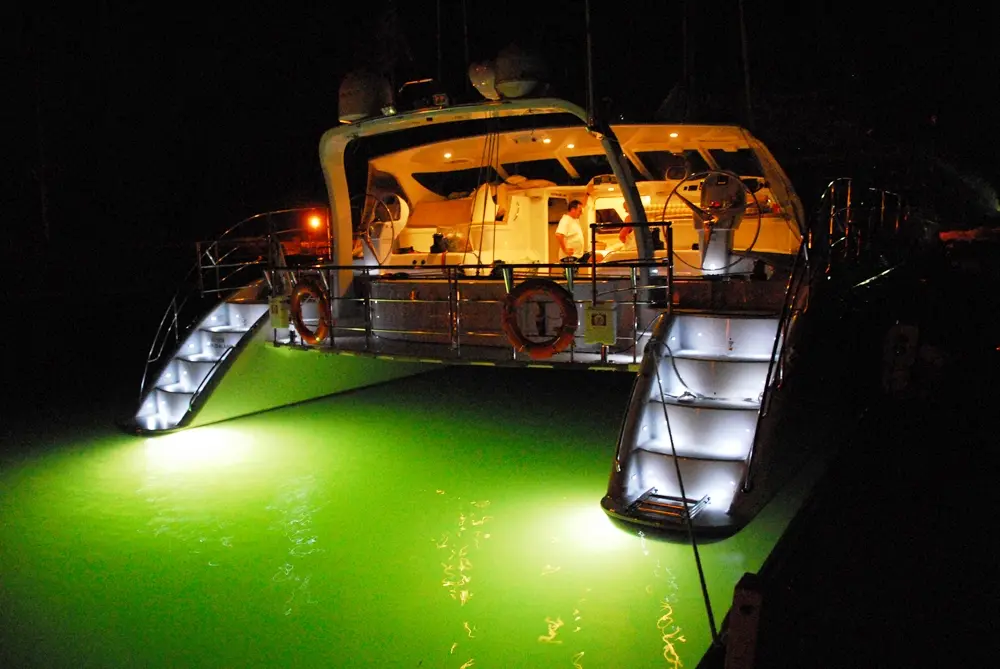
The turquoise glow spilling from a boat's hull at anchor at night is both a visual signature and a practical benefit: it lights up the water, attracts fish and the occasional curious onlooker, and makes getting in and out of the water from the swim platform safer. But underwater LED lighting is an electrical system mounted in the harshest environment on the boat, and a wrong choice or a poor installation can shorten the fixture's life or even trigger galvanic corrosion. This guide covers what works in the field, from choosing the right product to the mounting point, wiring and corrosion prevention.
Why LED, and what power level is enough?
Older-generation underwater lights were typically halogen, drawing heavy current and loading both the battery bank and producing significant heat. LED technology delivers the same visual effect at a fraction of the consumption. As a rough guide by boat size:
| Boat length | Lights (suggested) | Power per fixture | Total approx. current (12V) |
|---|---|---|---|
| 8–12 m | 2 | 10–20 W | 1.5–3 A |
| 12–18 m | 2–4 | 20–35 W | 3–10 A |
| 18–25 m | 4–6 | 35–60 W | 10–25 A |
These figures are only a rough reference; actual consumption varies by product, and you should factor the total load into your daily energy consumption guide.
Underwater lights can stay on for hours during an evening at anchor, so this load needs to be accounted for when sizing the battery bank and planning the charging strategy. A single compact fixture may suffice on a small sailboat, while a large motor yacht benefits from a symmetric layout on the transom and both sides of the hull.
Housing material: stainless, bronze or composite?
The housing material of an underwater fixture is decisive both for durability and for galvanic corrosion:
- 316L stainless steel offers a good look and reasonable durability, but is prone to pitting corrosion in seawater over time.
- Bronze and brass alloys have a long, proven track record in seawater, but must be chosen with galvanic compatibility to the boat's other underwater metals — shaft, propeller, trim tabs — in mind.
- Composite/polymer-housed fixtures are immune to corrosion entirely, which makes them a popular choice especially on boats with mixed underwater metals.
Whichever material is chosen, the fixture should be tied into the boat's existing cathodic protection system (anodes), with galvanic isolation maintained between dissimilar metals. See our galvanic corrosion and anodes article for the general principles.
On aluminium hulls in particular, the wrong material choice can cause serious damage in a short time; use the isolation kits the fixture manufacturer approves for aluminium hulls, and have the installation done by a team experienced with this detail. We regularly see cheap, unbranded fixtures skip these details and leave corrosion marks on the hull within a few seasons.
Mounting point and through-hull drilling
Underwater lights are usually mounted below the waterline on the transom or the side of the hull. When choosing a mounting point:
- Consider water flow and bubble formation, and avoid locations near the propeller or water intakes.
- Drill the through-hull opening strictly to the manufacturer's torque values and gasket instructions. A sealing mistake on an underwater installation puts more than the fixture at risk — it puts the boat at risk.
- Choosing between through-hull and surface-mount fixtures depends on hull thickness and yard facilities. Surface-mount fixtures offer an alternative that doesn't require a haul-out and are practical for retrofitting an existing boat.
Wiring and fusing
Underwater LED circuits operate in a permanently wet environment, so wiring needs to be more careful than standard interior circuits:
- Use tinned marine-grade copper cable. Heat-shrink, adhesive-lined connectors are preferred at connection points.
- Fuse each circuit separately. This ensures a short circuit or leak affects only the fixture involved, not the whole lighting system.
- Calculate voltage drop. On long cable runs from the transom to the panel, correct gauge sizing is critical; see our marine cable selection and voltage drop guide for the method.
- Keep junction boxes dry and accessible. Connector and driver boxes should sit in a compartment that stays dry and remains reachable for maintenance.
- Control them via a dedicated switch or relay. Underwater lights should be switched independently from saloon lighting; on larger boats they can be integrated into a digital switching system.
Sealing and IP rating
The minimum acceptable protection rating for underwater fixtures is IP68 — meaning the fixture withstands continuous submersion at a given depth. What the IP codes mean is explained in detail on IEC's official IP ratings page. Before buying, check the manufacturer's stated test depth and duration; some products labelled "waterproof" are only splash-resistant and not rated for continuous submersion. Manufacturers specialising in marine electronics, such as Lopolight, offer certified IP ratings on both underwater and navigation-light fixtures.
Colour choice and visual effect
The colour of underwater LED lights is both an aesthetic and a practical decision. Blue and turquoise are the wavelengths that travel furthest through water and give the most striking look on a boat at anchor at night. White light can also be impressive in clear, shallow water, but is quickly absorbed and loses effect in murky or deep water. Some manufacturers offer RGB or tunable colour options, appealing to owners who want to set different scenes when entertaining guests, but this requires an extra controller and generally more complex wiring. For those who want a simple, reliable system, single-colour, fixed-power fixtures remain the option with the fewest failure points.
Maintenance checklist
Since underwater LED systems face constant seawater exposure, they need regular inspection:
- Check gaskets and O-rings at least once a year, while hauled out, for cracking or hardening.
- Clean scale and marine growth off the fixture lens with a soft cloth; avoid abrasive materials.
- Check anode wear — adding underwater lights can increase anode demand.
- Look for moisture or corrosion signs at cable entry points.
- Test the driver circuit if you notice dimming or colour shift.
- Check that terminal screws in the fuse and junction box are tight — vibration can loosen them over time.
Combining these checks with your winterization maintenance significantly reduces the risk of surprise failures at the start of the season.
Work with Aslan Yacht on underwater lighting
From our workshop in Turgutreis to marinas across the Bodrum peninsula, we select underwater LED fixtures to match your boat's hull material and cathodic protection system, and carry out watertight mounting and correct wiring. Get in touch through our yacht lighting service or contact us to plan an assessment and installation.
Frequently asked questions
Can underwater LED lights stay on while the boat is underway?
Yes, quality underwater LED fixtures are built for continuous submersion and carry at least an IP68 rating. What matters is a watertight installation and proper electrical isolation between the housing and the hull.
What colour should underwater lights be?
Blue and turquoise travel furthest through water and look the most vivid; white light is striking closer to the surface in clear water. Some fixtures offer RGB colour-changing, but that needs extra wiring and a controller.
Does installing underwater LEDs cause galvanic corrosion?
It can be a serious risk without the right material, isolation and grounding. Underwater fixtures should be tied into the boat's cathodic protection system, galvanically isolated from dissimilar metals, and the anodes checked regularly.